

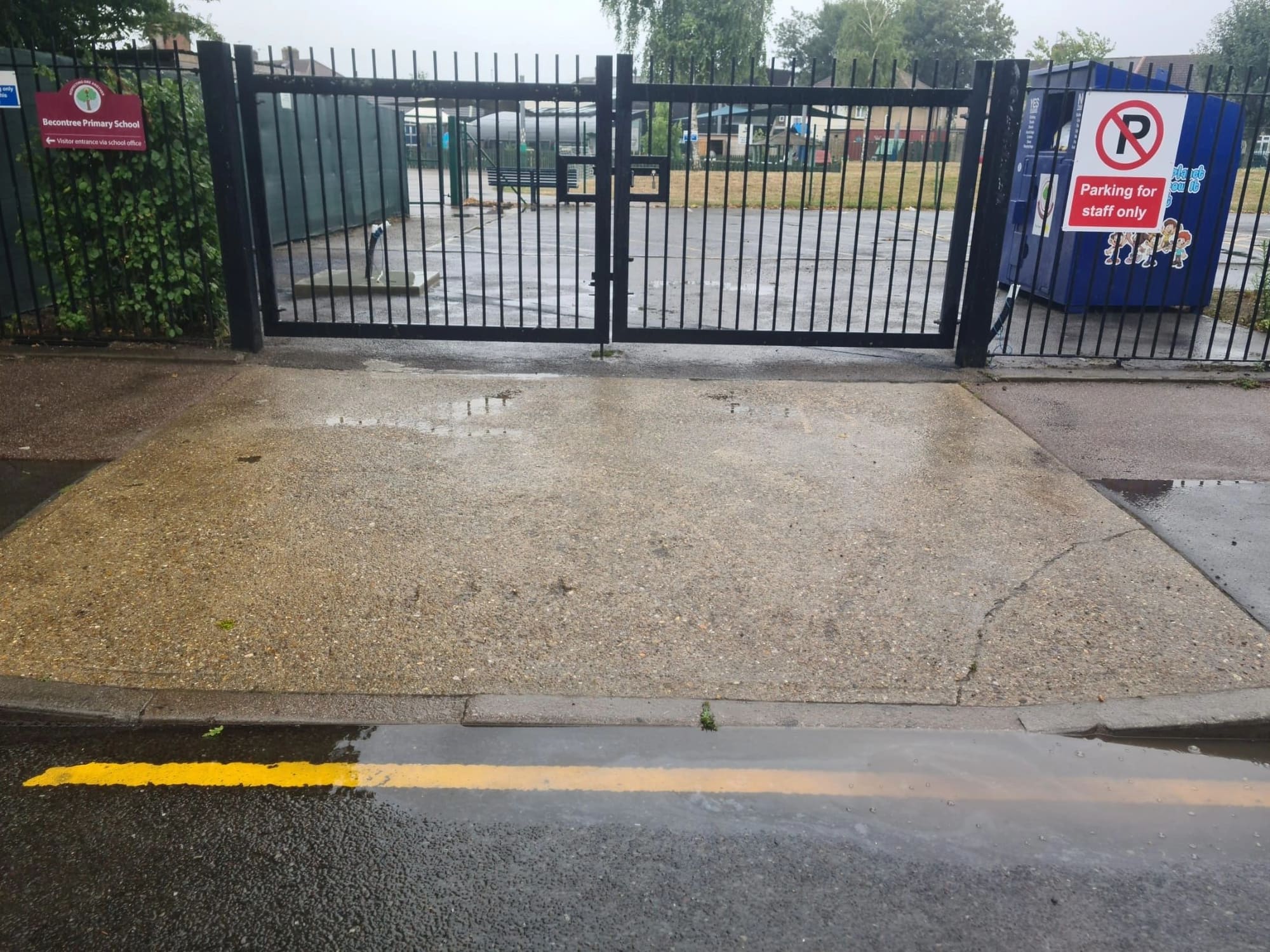
Domestic supply
The pipe running from the boundary stop tap to the house, usually buried under a lawn or a drive. This is the one behind most surprise bills, and the one people are surprised to learn they own.
Access solutions
Finding a water leak without opening up the whole site, then repairing it and putting the surface back the way it was.
Most people ring about a symptom rather than a leak. The water bill has jumped with nothing changed at home. There is a damp patch on a wall, or a soft spot in the lawn that never dries out. Pressure has dropped. The meter dial is still turning with every tap in the building shut off. A warm patch on a floor usually points to the heating, not the mains.
Non destructive detection means we work out where the water is escaping before anything is opened up. Acoustic listening picks up the noise a pressurised leak makes through a hard surface. Correlation puts a sensor at each end of a pipe run and works out the position from the difference in arrival time. Tracer gas is pushed into a drained pipe and picked up at the surface where it rises. Thermal imaging finds heating leaks by temperature.
No single method finds everything. A noisy mains leak under a concrete drive can be pinpointed in an hour. A slow weep on a plastic pipe two metres down makes almost no sound, and that one takes pressure testing, isolation of sections and patience. We choose the method from the pipe, the material, the depth and the surface, and we will tell you when a job is going to be a long one.
Finding it is only half of the work. A detection only company hands you a mark on the ground and leaves you to find a groundworker, then a surfacing contractor, then somebody to make the two of them turn up in the right order. We dig, repair or replace the failed section, backfill in layers and put the concrete, tarmac or resin back ourselves.
It is worth knowing where your responsibility starts. On a domestic property the supply pipe from the boundary stop tap into the house is normally the homeowner's, and everything on the street side belongs to the water company. A leak on your side is yours to fix, and it carries on billing while it runs. Some water companies will contribute to a repair on a private supply pipe, so it is worth asking yours before you commit.
The pipe running from the boundary stop tap to the house, usually buried under a lawn or a drive. This is the one behind most surprise bills, and the one people are surprised to learn they own.
Longer runs under yards, car parks and estate roads, often serving several buildings off one meter. Correlation and section isolation matter more here, because guessing wrong means opening a car park rather than a flower bed.
A wet underfloor circuit or a buried heating pipe losing water shows up as a warm patch, a dropping boiler pressure or a floor that never quite dries. Thermal imaging usually gets there fastest.
On site
The same five stages every time, with the programme written down before anybody starts digging.
Book a site visitWe come out and look at the ground, the power, the drainage, the traffic and the risk, and take measurements on site instead of guessing from a photograph.
A drawing and an itemised quotation naming the exact equipment, so you can compare it like for like with anyone else you have asked.
Excavation, drainage, ducting and foundations, carried out by our own team to the programme we agreed.
Fit, wire, set the force limits, prove the safety devices and test the whole system before anybody signs it off.
The paperwork, and a walkthrough for whoever uses it every day.
Common questions
Turn every tap and appliance off and watch the water meter. If the dial is still moving, water is going somewhere. Other signs are a bill that has climbed with nothing changed, a drop in pressure, a patch of ground that stays green in dry weather or a floor that feels warm.
That is the point of detecting first. The aim is to open one small area over the leak rather than chase the pipe along its length. We cannot promise a single hole on every job, because some pipes have more than one fault, but the work is always to narrow it down before a spade goes in.
It happens. A leak on a plastic pipe, deep, under a thick slab, with traffic noise around it can defeat the first method tried. We will say so, we will not dig on a hunch, and we will explain what the next step would be, whether that is tracer gas, isolating the run in sections or exposing a joint we already suspect.
Both. We repair or replace the failed section, backfill the trench in layers and put the surface back, whether that is concrete, tarmac, resin or block paving. Groundworks and surfacing are our own trades, so you are not left holding a mark on the ground and a list of other numbers to ring.
As a rough rule, the pipe from the boundary of your property into the building is yours, and the main in the street is theirs. Where the leak sits either side of that line changes who pays for the repair. If the detection shows it is on their side, you will know before you spend anything on digging.
Ground penetrating radar surveys that show what is buried under a site before a machine goes anywhere near it, across London and the counties around it.
Read moreExcavation, drainage, service trenches and ducting, dug by our own team and put back so the ground above stays sound long after we have gone.
Read moreDriveways, paths, block paving and concrete bases, laid by the same team that digs the ground out and builds what sits underneath.
Read more
Send a photograph and a postcode and we will come back to you with what the site needs.